
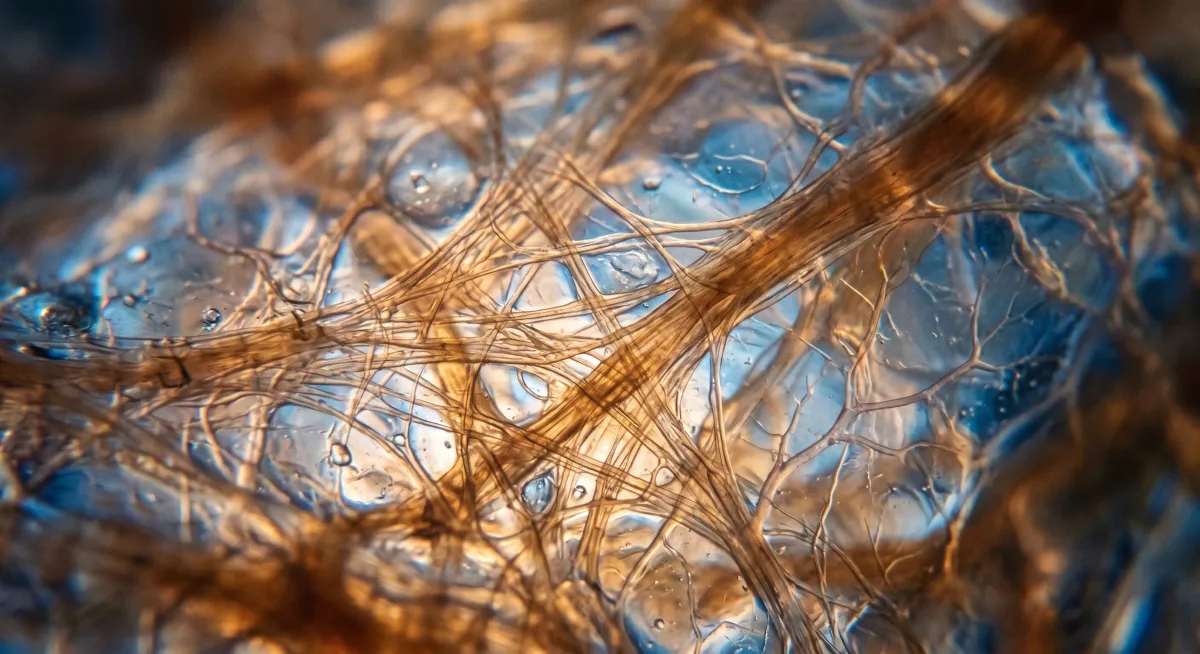
Your Richest Sensory Organ: How Fascia Influences Pain Perception and Longevity
TLDR: Fascia is densely innervated with an estimated 250 million nerve endings and functions as an active sensory tissue, not passive structural wrapping. Restricted fascial mobility reduces proprioceptive input to the nervous system, which helps explain diffuse achiness and body-awareness complaints in clients with clean imaging. Manual therapy that addresses fascial layers is providing afferent sensory input — the mechanical model alone does not account for what is happening.
There's a client most of us have seen. She's in her late forties, active, no history of major injury. She comes in reporting diffuse achiness, trouble knowing where her body is in space, a vague sense that things just don't "work right" anymore. Her imaging is clean. Her ortho cleared her. She's been told it's just aging.
Spend enough time in practice and you stop accepting that answer. Because what's often happening isn't in the joint or the muscle belly. It's in the tissue that wraps everything, and it's been signaling the whole time.
If you trained the way most of us did, fascia was presented as packaging. The white stuff you cut through to get to the real anatomy. Peel it back, find the muscle, do your work. I spent years thinking about fascia primarily in structural terms: a force transmitter, a glide surface, a source of restriction when things went wrong. That framing wasn't wrong. It was just incomplete.
The research that has accumulated over the past decade has repositioned fascia from passive wrapping to active sensory tissue. The clinical implications are significant, and most practitioners haven't fully caught up to them yet.
If you want to build a deeper working understanding of fascial physiology before reading further, A Field Guide to Fascia covers the tissue properties and sensory layers in detail. It's worth having that foundation in place.
Fascial Innervation and Proprioception
Fascia is one of the most densely innervated tissues in the body, with a sensory role that goes well beyond structural support. The thoracolumbar fascia alone contains mechanoreceptors responsible for afferent proprioceptive signaling — the continuous stream of information that tells the nervous system where the body is and how it's moving [1]. Most manual therapists contact this structure in nearly every session.
A 2022 systematic review on fascial innervation concluded that fascia may warrant consideration as the body's largest sensory organ, given its total surface area and its active role in both proprioception and nociception [2]. The estimated total nerve endings in the human fascial network: approximately 250 million [3]. For context, the skin has roughly 64 nerve endings per cm² in the hip region. The superficial fascia of the same area registers approximately 33 per cm² [3]. The gap is smaller than most people expect.
Around 80% of the nerves in fascia terminate as free nerve endings, transmitting signals that contribute to both proprioceptive and interoceptive functions [4]. These are slower, more diffuse signals than what comes from the fast mechanoreceptors in joint capsules. They don't give sharp joint-angle data. They build the background sense of where you are, how you're loaded, and whether something feels off.
That distinction matters clinically. A client who says "I just feel tight everywhere but I can't tell you where" may not be catastrophizing or being vague. They may be accurately reporting what their fascial sensory system is telling them.
Fascial mechanoreceptor: A nerve ending embedded within fascial connective tissue that converts mechanical stimuli — tension, compression, shear, vibration — into afferent neural signals. In fascia, these include Ruffini endings, Golgi tendon organ-like structures, Pacinian corpuscles, and interstitial free nerve endings, each responding to different stimulus qualities and contributing to proprioceptive and interoceptive processing.
How Fascial Restriction Reduces Sensory Output
Restricted fascial mobility reduces the responsiveness of strain-sensitive mechanoreceptors, diminishing the quality of sensory information reaching the nervous system. Helene Langevin, Director of the National Center for Complementary and Integrative Health at the NIH, has spent years studying fascial mobility and its relationship to proprioception and pain. Her 2021 review found that restricted mobility along the shear planes that allow adjacent muscle layers to glide may reduce sensory input from those regions [5]. When layers stop gliding, signal output drops. When signal output drops, the nervous system works from a less accurate map.
The downstream effects compound. Restricted fascia produces less sensory output. The brain gets a less accurate map of what's happening in that region. A poor map leads to imprecise motor output. Imprecise motor output increases uneven loading. Uneven loading accelerates restriction. This pattern is visible in clients who have been compensating for years without a clear precipitating event.
Langevin's research also found that people with chronic low back pain show up to 25% thickening of the thoracolumbar fascia compared to pain-free individuals [5]. This structural change correlates with reduced shear mobility between fascial layers and with increased nociceptive sensitivity. The fascia isn't just transmitting a pain signal from somewhere else. It's generating part of it.
A 2025 integrative model published in Frontiers in Pain Research described how fascial densification, fibrosis, and local inflammation can sustain nociceptive input independent of the original injury [6]. The tissue holds onto the story long after the acute event has resolved. What practitioners sometimes interpret as central sensitization may have a significant peripheral fascial component that is quite accessible to manual work — if you're thinking about it that way.
Fascial densification: A pathological process in which hyaluronic acid within the fascial matrix loses its normal viscosity and becomes more gel-like, reducing the glide capacity between adjacent fascial layers. Unlike fibrosis, densification is not an excess of collagen — it's a change in the ground substance that decreases shear mobility and, by extension, mechanoreceptor responsiveness.
Interoception, Manual Therapy, and the Sensory Response
Deep pressure applied to fascial structures directly stimulates interstitial free nerve endings and modulates interoceptive signaling. Interoception is the body's ability to sense, interpret, and regulate its own internal signals. It includes more than organ sensation — it encompasses the felt sense of tissue state, load, and internal coherence that arises from deep connective tissue, including fascia [5].
The "de qi" sensation familiar to anyone who's practiced acupuncture is thought to arise from this same mechanism: connective tissue stretch activating diffuse interoceptive receptors, not just localized muscle reflex. The same principle applies in myofascial release and manual therapy. When your client exhales slowly on the table as you sink into a particular layer, something real is happening neurologically. You're providing input to a sensory system that connects tissue state to the nervous system's global threat assessment.
Pace and depth matter here beyond their biomechanical effects. Approaching slowly and pausing gives mechanoreceptors time to respond to the change in load before you progress. A practitioner I trained with early on used to say that good hands "listen before they press." It sounds like craft-room wisdom. It maps accurately onto the physiology.
For practitioners who want to work directly with this sensory layer, A Field Guide to Fascia covers the clinical application in detail, including how to apply these principles to assessment and treatment planning. 1 CE credit, fully online.
Fascial Aging, Hydration, and What Clients Are Actually Reporting
Aging reduces hyaluronic acid production and slows collagen synthesis, causing progressive loss of fascial glide capacity. Hyaluronic acid within the fascial matrix is the primary mechanism for lubrication between layers. As it declines, layers that once glided freely begin to adhere and stiffen [7]. The morninginess, the sense of being locked up until they've moved for an hour, the diffuse stiffness that has no obvious source — these are signs of a fascial system losing its hydration and range.
Movement is the primary mechanism that keeps this system functional. Compression and decompression of fascial tissue drives fluid in and out, maintaining the ground substance in a state that supports glide. A sedentary lifestyle, even interspersed with exercise, is insufficient if most hours are spent in static loading. The fascial matrix responds to variety and range, not just volume.
A client who understands that their mobility tomorrow depends on how much their fascia moves today has a different relationship with their homecare. Movement becomes biological maintenance. That reframe motivates differently than "you should stretch more."
What This Changes Clinically
None of this asks you to stop thinking structurally. Fascial lines, load transfer, tissue layers: all of that still matters. What changes is the lens.
When a client's tissue doesn't respond the way you expect, the problem may not be your technique. The sensory system in that tissue may be producing something — guarding, a pain signal, a proprioceptive mismatch that is directing the response. Pressing harder into it won't help. Changing the sensory input might.
When you sink slowly into a tissue plane and feel it organize under your hands, you are providing afferent input to a sensory network that is reporting to the nervous system in real time. The tissue response you feel is partly a nervous system response. Understanding what you're talking to is what separates mechanical treatment from clinical reasoning.
And when your client with diffuse achiness and body-awareness difficulty comes back three weeks later and says things feel different — clearer somehow — the explanation probably isn't that you stretched collagen fibers into a new position. You restored some of the sensory signal the fascial network had stopped producing.
References
[1] Kopeinig, C., Goedl-Purrer, B., & Salchinger, B. Fascia as a Proprioceptive Organ and its Role in Chronic Pain: A Review of Current Literature. Safety in Health, 2015. https://safetyinhealth.biomedcentral.com/articles/10.1186/2056-5917-1-S1-A2
[2] Suarez-Rodriguez, V., Fede, C., Pirri, C., Petrelli, L., Loro-Ferrer, J.F., Rodriguez-Ruiz, D., De Caro, R., & Stecco, C. Fascial Innervation: A Systematic Review of the Literature. International Journal of Molecular Sciences, 23(10), 5674. 2022. https://doi.org/10.3390/ijms23105674
[3] Fede, C., et al. Innervation of human superficial fascia. Frontiers in Neuroanatomy, 2022. https://www.frontiersin.org/journals/neuroanatomy/articles/10.3389/fnana.2022.981426/full — The 250 million nerve endings figure is attributed to Schleip (2020) within this paper.
[4] Schleip, R. (2021). Fascia as a sensory organ. Referenced in Fascia-Informed Therapist (2024).
[5] Langevin, H.M. Fascia Mobility, Proprioception, and Myofascial Pain. Life, 11(7), 668. 2021. https://pubmed.ncbi.nlm.nih.gov/34357040/
[6] Exploring fascia in myofascial pain syndrome: an integrative model of mechanisms. Frontiers in Pain Research, 2025. https://www.frontiersin.org/journals/pain-research/articles/10.3389/fpain.2025.1712242/full [7] Langevin, H.M., et al. Ultrasound evidence of altered lumbar connective tissue structure in human subjects with chronic low back pain. BMC Musculoskeletal Disorders, 12:151. 2011.