
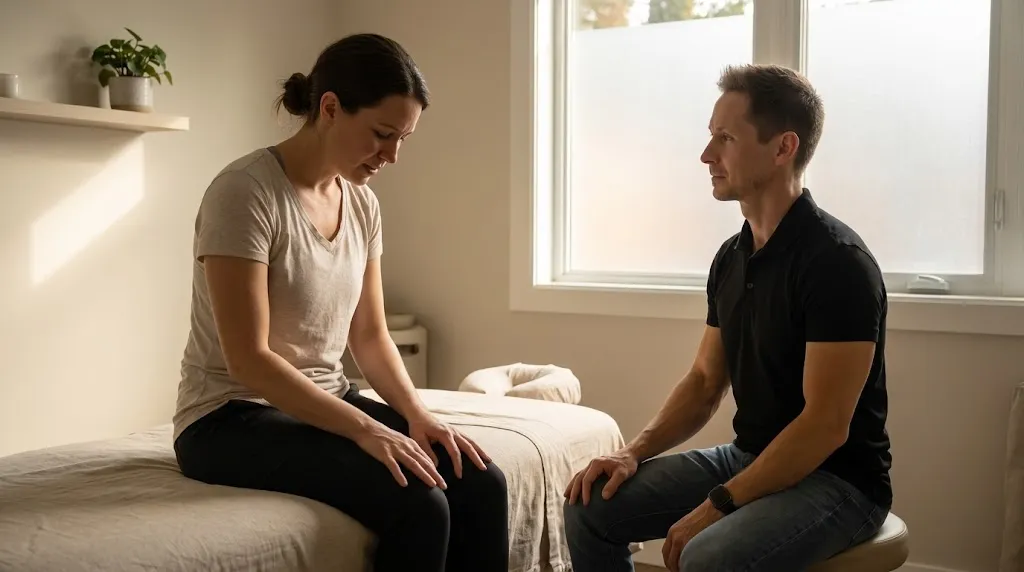
What Is Therapeutic Presence and Why Does It Matter More Than Your Technique
TLDR: Therapeutic presence is a practitioner's capacity to be fully available, physically, emotionally, and neurologically, in a way that the client's nervous system registers as safe before treatment begins. It is grounded in measurable physiology: a regulated practitioner operating in a state of cardiac coherence creates the conditions for co-regulation through entrainment, which is the primary mechanism that allows any manual therapy or acupuncture intervention to actually land. You cannot fake it, and you cannot outsource it to technique.
Table of Conten
Defining Therapeutic Presence: The Clinical Model
The Polyvagal Foundation: Why the Nervous System Detects Presence Before You Speak
Cardiac Coherence and Entrainment: The Mechanism Underneath Presence
Interoception and the Practitioner's Internal Channel
The Environment Is Part of Therapeutic Presence
I used to think the most important thing I could bring into a treatment room was what I knew. The right assessment, the correct needle placement, the precise fascial approach. I spent years accumulating clinical knowledge and I still think that matters, a lot. But somewhere in year ten of practice, I started noticing a pattern that my clinical training had no language for.
The sessions where clients made the most progress were not always the sessions where I had the clearest protocol. They were the sessions where I had shown up settled. Unhurried. Without an agenda I was emotionally attached to. And the sessions that stalled, where clients guarded, where tissue didn't respond, where nothing seemed to reach, those were often the sessions where I had walked in tight. Preoccupied. Performing presence rather than actually inhabiting it.
This is the piece the continuing education industry almost never addresses. In the Acupressure and Meridian Massage course at AIM Wellness Education, therapeutic presence is treated as a foundational skill that every hands-on practitioner needs before technique ever enters the room.
It took me years to find the research that named what I was observing. When I did, it changed how I thought about every clinical skill I had spent a decade developing.
Defining Therapeutic Presence: The Clinical Model
Therapeutic presence is the state of having one's whole self available in the encounter with a client, physically, emotionally, cognitively, and relationally, in a way that communicates safety at a neurological level rather than just an interpersonal one.
The most rigorous formal definition comes from the work of Geller and Greenberg, who conducted qualitative research with experienced psychotherapists and concluded that therapeutic presence involves bringing one's whole self into the encounter, being completely in the moment on multiple levels simultaneously. [1] Their subsequent research found that therapeutic presence was a foundation for positive therapeutic alliance and session outcomes across multiple therapy modalities, and critically, that clients' perceptions of a therapist's presence predicted outcomes more reliably than therapists' own self-reports. [2]
That finding is worth sitting with. We are not especially good judges of our own presence. The client's nervous system, however, is monitoring it continuously.
Therapeutic Presence Defined
Therapeutic presence is the practitioner's capacity to bring their regulated, undivided self into contact with a client's experience, without projection, without performance, and without agenda, in a way that the client's autonomic nervous system registers as safe. It is distinct from clinical empathy or active listening, though it encompasses both. Therapeutic presence is a physiological state as much as an interpersonal one. It is what happens before any technique begins, and it is what determines whether the technique reaches its target.
The Polyvagal Foundation: Why the Nervous System Detects Presence Before You Speak
The reason therapeutic presence has measurable clinical effects is that the human nervous system does not wait for a verbal cue before deciding whether it is safe. It decides before you open your mouth.
Dr. Stephen Porges' Polyvagal Theory describes this through the concept of neuroception: the nervous system's continuous, subconscious evaluation of whether the current environment, and the people in it, are safe, dangerous, or life-threatening. [3] Neuroception is not perception. It does not require conscious processing. It operates below awareness through neural circuits that assess voice prosody, facial expression, postural cues, and bodily signals in the environment. It is why a baby coos at a familiar caregiver and cries at a stranger before any cognitive recognition occurs. [4]
In a clinical context, this means a client's nervous system is evaluating you before you have laid a hand on them. The evaluation is not based on your credentials. It is based on your state. A practitioner who walks into the room dysregulated, rushed, anxious, distracted, emotionally unfinished from the last session, sends signals the client's neuroception reads as threat-adjacent. The tissue response that follows is predictable: guarding, reduced range, a nervous system that resists rather than receives.
A calm, attuned practitioner anchors the therapeutic environment in a way that enables clients to feel heard and physiologically safe. A dysregulated therapist can unwittingly reinforce a client's neuroception of danger. [5] This is not metaphor. It is the actual mechanism by which presence either opens or closes the window for therapeutic work.
What Is Neuroception?
Neuroception, a term coined by Dr. Stephen Porges, describes the automatic, subconscious neural process by which the autonomic nervous system continuously evaluates environmental and interpersonal cues for safety, danger, or life threat, without conscious awareness. It operates through circuits that assess three channels simultaneously: the external physical environment, social cues in other people (particularly faces and vocal prosody), and the individual's own interoceptive state. Neuroception drives autonomic state shifts toward social engagement or away from it before any conscious interpretation occurs.
Cardiac Coherence and Entrainment: The Mechanism Underneath Presence
Here is where the physiology gets specific, and where most discussions of therapeutic presence stop short.
A practitioner in a regulated state is not just psychologically calm. Their autonomic nervous system is operating in what HeartMath Institute researchers call cardiac coherence: a state in which heart rhythm patterns become ordered and sine-wave-like at approximately 0.1 Hz, with synchronized entrainment between respiratory, cardiovascular, and brain rhythms. [6] This coherent state is characterized by increased parasympathetic tone, higher heart rate variability (HRV), and synchronized communication between the heart, brain, and gut.
The clinical relevance lies in what happens next. Two physiological systems that are capable of oscillating at the same frequency tend to shift toward synchronization, a phenomenon called entrainment. A coherent practitioner does not just feel calmer; they become, in effect, the dominant oscillator in the room. HeartMath's research supports the principle that an individual in a state of coherence can influence the physiological state of people in proximity through this entrainment dynamic. [7]
Think of it this way: picture a wall with a hundred pendulum clocks and one large clock at the centre. Set the large one swinging and within a short time, the smaller ones have synchronized to it. This is not magic. It is resonance. A regulated practitioner is the large clock.
The inverse is equally true. Low HRV, associated with autonomic dysregulation, chronic stress, and sympathetic dominance, does not stay contained to the practitioner. The client's system picks up the signal. The treatment begins before treatment begins, and the quality of your nervous system in those opening moments shapes what is available to both of you.
Interoception and the Practitioner's Internal Channel
There is a third component of therapeutic presence that connects Polyvagal Theory, HeartMath coherence, and the clinical encounter: interoception.
Interoception is the practitioner's capacity to sense and interpret signals arising from their own body in real time. It is the substrate of clinical intuition, not a mystical phenomenon, but the developed ability to trust what your body is communicating about the client's tissue, the relational field, and the current moment. The more a practitioner has cultivated genuine self-awareness, the more their interoceptive read of a session can be trusted.
This is also why therapeutic presence cannot be performed. A practitioner who is internally dysregulated but externally composed creates a mismatch that neuroception detects. Clients often describe this feeling without words for it. Something feels off, they don't fully relax, the work doesn't quite reach them. The mismatch is real. The nervous system reads it.
Developing interoception as a clinical skill is part of what distinguishes a technically competent practitioner from a genuinely effective one. It requires honest self-observation, and it requires the practitioner to have done enough inner work that their own responses are available information rather than noise.
In the Acupressure and Meridian Massage course, this internal attunement is explored specifically in the context of hands-on work, where the practitioner's own state is inseparable from how meridian-based touch is received and integrated.
The Environment Is Part of Therapeutic Presence
Therapeutic presence is not only what the practitioner brings. It is the full context of safety the client's neuroception is scanning.
Recall that neuroception evaluates three channels: the external environment, social cues in other people, and internal visceral state. The physical treatment environment speaks to the first channel. Lighting, sound, temperature, the pace at which you move through the room, the absence of clinical urgency in the space itself, all of this is read before words are exchanged. A cluttered, overlit, hurried environment sends a different signal than one that communicates care and unhurriedness.
This means that building therapeutic presence is partly about building a therapeutic environment. The two are inseparable.
What This Comes Down to for You
Technical skill matters. Assessment matters. Clinical reasoning matters. None of that is in question.
But here is what the research says: your client's nervous system is making a safety determination about you before you have assessed a single structure. That determination shapes tissue tone, guarding patterns, pain thresholds, and the client's capacity to receive any intervention you offer. The most precise orthopedic technique in the world runs into a wall if the nervous system receiving it has already gone into defense.
Therapeutic presence is what gets you through that wall. It is not soft. It is not secondary. It is the substrate on which everything else you do either lands or doesn't.
The practitioners who consistently get results that outlast the treatment session, the ones clients talk about, the ones who build practices without having to advertise, are not always the ones with the most certifications. They are the ones who have done the work on their own nervous system. Who show up settled. Who have enough inner clarity that their presence itself is part of the treatment.
If you want to explore how therapeutic presence integrates directly with hands-on acupressure and meridian-based work, the Acupressure and Meridian Massage course at AIM Wellness Education goes deep into both the energetic and neurological dimensions of this kind of contact.
If this is the part of your clinical development you have been neglecting, start here: Acupressure and Meridian Massage — AIM Wellness Education
References
[1] Geller, S.M. & Greenberg, L.S. "Therapeutic Presence: Therapists' Experience of Presence in the Psychotherapy Encounter." Person-Centered and Experiential Psychotherapies, 1(1-2), 2002. https://doi.org/10.1080/14779757.2002.9688279
[2] Geller, S.M., Greenberg, L.S. & Watson, J.C. "Therapist and client perceptions of therapeutic presence: The development of a measure." Psychotherapy Research, 20(5), 2010. https://doi.org/10.1080/10503301003764338
[3] Porges, S.W. "Polyvagal Theory: A Science of Safety." Frontiers in Integrative Neuroscience, 2022. https://pmc.ncbi.nlm.nih.gov/articles/PMC9131189/
[4] Porges, S.W. "Neuroception: A Subconscious System for Detecting Threats and Safety." Zero to Three, 24(5), 2004. https://eric.ed.gov/?id=EJ938225
[5] Finn, M.T.M., et al. "Polyvagal Theory: Current Status, Clinical Applications, and Future Directions." PMC, 2025. https://pmc.ncbi.nlm.nih.gov/articles/PMC12302812/
[6] HeartMath Institute. "Coherence." Science of the Heart, 2023. https://www.heartmath.org/research/science-of-the-heart/coherence/
[7] Elbers, J. & McCraty, R. "From Dysregulation to Coherence: Exploring the HeartMath Approach to Emotional and Physiological Regulation." Integrative Medicine: A Clinician's Journal, 2025. https://journals.sagepub.com/doi/10.1177/27536130251408821