The Anatomy of Anxiety: How Physical Points Influence Emotional Resilience
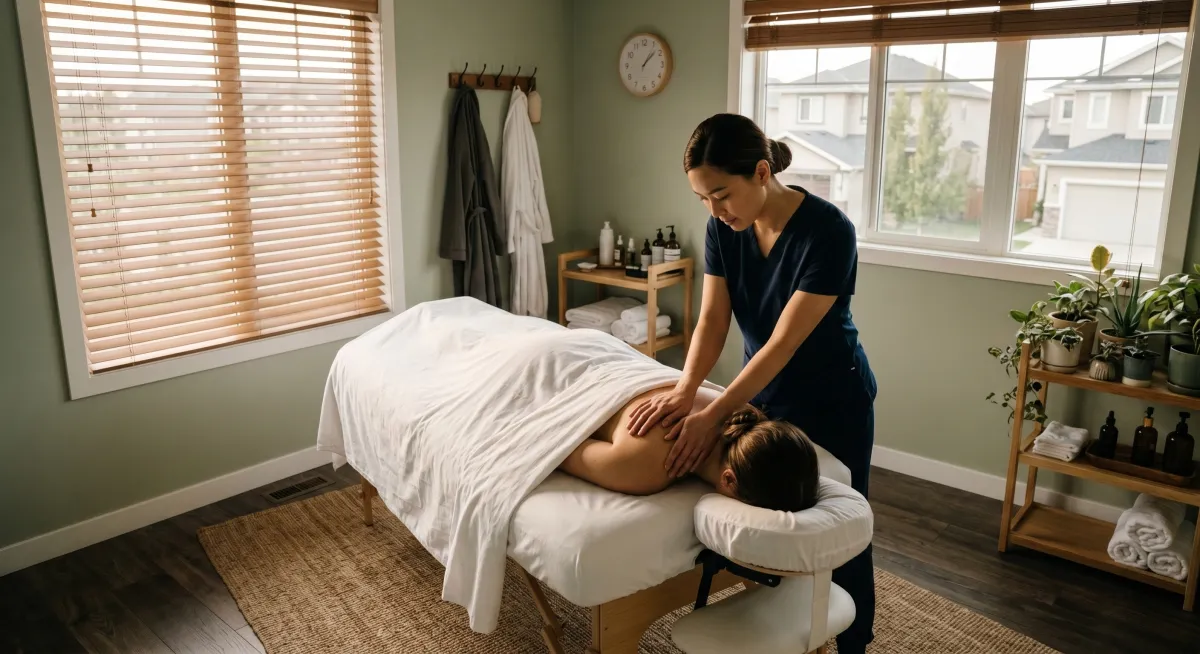
There's a moment most manual therapists know well. The client is on the table, you've worked through the neck and shoulders, and somewhere around the third pass through the upper traps, something releases that isn't muscular. The breath changes. The jaw unclenches. Sometimes there's a sudden well of emotion, a few quiet tears, or just a long exhale that sounds like something finally being set down.
You didn't try to do that. You were treating tissue. And yet.
This isn't a coincidence, and it's not magic. There's a physiology behind it, and understanding it makes you a more confident clinician, especially when anxious clients are walking through your door in increasing numbers.
The Stress Cycle Lives in the Body
Anxiety isn't only a thought pattern. It's a full-body state, driven by a nervous system that has learned, often for good reasons, to stay primed for threat.
When the stress response fires, the hypothalamic-pituitary-adrenal (HPA) axis releases cortisol. The sympathetic nervous system raises heart rate, tightens the respiratory accessory muscles, and loads the posterior chain. The body prepares to fight, flee, or freeze. All of that is physiology, and physiology responds to physical input.
The research on this is reasonably clear. A review from the Touch Research Institute at the University of Miami, published in the International Journal of Neuroscience, found that massage therapy produced measurable biochemical changes, including reduced cortisol and increased serotonin and dopamine, across a wide range of populations and conditions. [1] A 2024 systematic review and meta-analysis published in Nature Human Behaviour, which examined the effects of touch interventions on physical and mental health, found that receiving touch was effective for reducing pain, depression, and anxiety, with more frequent sessions showing greater improvement in anxiety outcomes in adults. [2]
The mechanism isn't mysterious. Pressure receptors in the skin and fascia send afferent signals into the brainstem, activating the parasympathetic branch of the autonomic nervous system. Heart rate slows. The HPA axis is gently suppressed. The body gets a signal that it's safe to come down. [3]
That's what you're doing every time a client leaves your table feeling unexpectedly lighter than when they came in. You're not just moving tissue. You're talking directly to the nervous system.
Where TCM Gives Us a Better Map
Western neurophysiology explains the mechanism well enough. But TCM offers something the physiology alone doesn't: a clinical framework that has been mapping the relationship between physical contact and emotional state for over two thousand years.
In Chinese medicine, anxiety and emotional dysregulation aren't separate from the body. They're expressions of it. The system doesn't draw a hard line between a tight neck and a restless mind, or between chronic bracing in the chest and difficulty feeling safe. These are understood as the same pattern, showing up at different layers. That perspective changes how you assess what's in front of you, and where your hands go.
What's useful for manual therapists isn't learning to think like an acupuncturist. It's borrowing the lens. When you start reading tension patterns through a TCM framework, you notice things you might have written off as purely mechanical. The client whose chest and anterior shoulders never fully release. The one whose treatment responses are inconsistent in ways that don't make anatomical sense. The person who's holding something that isn't in the tissue alone.
A Word on Scope, and Why This Framework Actually Protects You
Here's something worth naming directly. In the massage and manual therapy world, we work with soft tissue. That's our scope, and it's a clear one. We're not diagnosing anxiety disorders. We're not providing psychotherapy. We don't assess or treat mental health conditions.
But anxious clients sit on our tables every day, and they often arrive with a body that has been carrying their stress long enough to show it: the elevated upper traps, the shallow breathing, the cervical tension that never fully responds to mechanical treatment alone.
The TCM framework gives us something useful here, and it's not just clinical depth. It's clinical language. TCM has a long tradition of describing emotional and physiological states through the body, in terms that are grounded in tissue, pattern, and function rather than psychological diagnosis. That gives the manual therapist a vocabulary for what they're observing and doing, without crossing into mental health territory.
You're not treating anxiety. You're working on soft tissue using a framework that acknowledges the nervous system, respects the mind-body relationship, and gives you language to explain what you're doing to clients without overpromising. When a client asks why they always feel emotionally lighter after their sessions, you can speak to what you know: that the nervous system lives in the body, that skilled touch has measurable effects on autonomic regulation, and that these patterns have been documented in both ancient clinical tradition and modern research.
That clarity also protects the therapeutic relationship. There's a particular kind of trust that builds when a client senses you understand what's happening in their body at more than a mechanical level. You don't have to name it as anxiety. You don't have to venture into emotional processing. What you bring is therapeutic presence, the quality of attention that communicates, without words, that you've seen this pattern before, that you know what to do with it, and that nothing needs to be fixed or explained. That kind of presence is its own clinical intervention, and the TCM lens, used this way, supports rather than complicates it.
It also keeps you on the right side of your scope, not because you're being cautious, but because you actually understand the distinction.
What This Looks Like in Practice
Consider a client who books for neck and shoulder tension, which is how most of the anxiety-driven work walks in the door. She describes herself as a "stressed person" but isn't there for her stress. She's there because her neck hurts.
You work through your standard protocol. When you reach the upper traps and suboccipitals, you notice the tissue quality is more reactive than the presentation suggested. Guarded. During the session, you spend a few minutes on PC6, incorporated naturally into your forearm work. You finish with light pressure at Yintang as part of your closing sequence.
She doesn't know those are "anxiety points." She knows her neck feels better and that she's somehow calmer than she expected to be. You've done nothing outside your scope. You've treated soft tissue with intention, using a framework that gave you additional clinical precision.
That's the value of understanding the anatomy beneath the anxiety.
What This Means for the Way You Work
Anxious clients aren't a niche population anymore. They're the majority. The research supports using manual pressure to interrupt the stress cycle, and the TCM framework gives you a point-specific vocabulary to do it more precisely, and to explain it to clients and colleagues in language that holds up clinically.
This doesn't require you to become an acupuncturist or to step outside what you were trained to do. It requires understanding the physiology underneath the work you're already doing, and choosing your contact points with more intention.
If you want to build a practical working knowledge of these points and how to integrate them into your existing sessions, the Acupressure for Stress Relief course was built for exactly this. It gives you the clinical anatomy, the point locations, and the protocols to apply this confidently in your practice. Fully online and designed for Canadian practitioners.
References
[1] Field, T., Hernandez-Reif, M., Diego, M., Schanberg, S., & Kuhn, C. (2005). Cortisol decreases and serotonin and dopamine increase following massage therapy. International Journal of Neuroscience, 115(10), 1397–1413. [Please verify this citation before publishing.]
[2] Packheiser, J., Hartmann, H., Fredriksen, K., Gazzola, V., Keysers, C., & Michon, F. (2024). A systematic review and multivariate meta-analysis of the physical and mental health benefits of touch interventions. Nature Human Behaviour, 8, 1841–1854. https://doi.org/10.1038/s41562-024-01841-8
[3] Field, T. (2016). Massage therapy research review. Complementary Therapies in Clinical Practice, 24, 19–31. https://doi.org/10.1016/j.ctcp.2016.04.005
[4] Chen, Y.-W., & Wang, H.-H. (2014). The effectiveness of acupressure on relieving pain: a systematic review. Pain Management Nursing, 15(2), 539–550. [Please verify this specific citation before publishing — the PubMed systematic review on acupressure and anxiety cited in this post is PMID 26002571.]
[5] Zhu, J., et al. (2024). Acupressure: a possible therapeutic strategy for anxiety related to COVID-19: a meta-analysis of randomized controlled trials. Frontiers in Medicine, 11, 1341072. https://doi.org/10.3389/fmed.2024.1341072